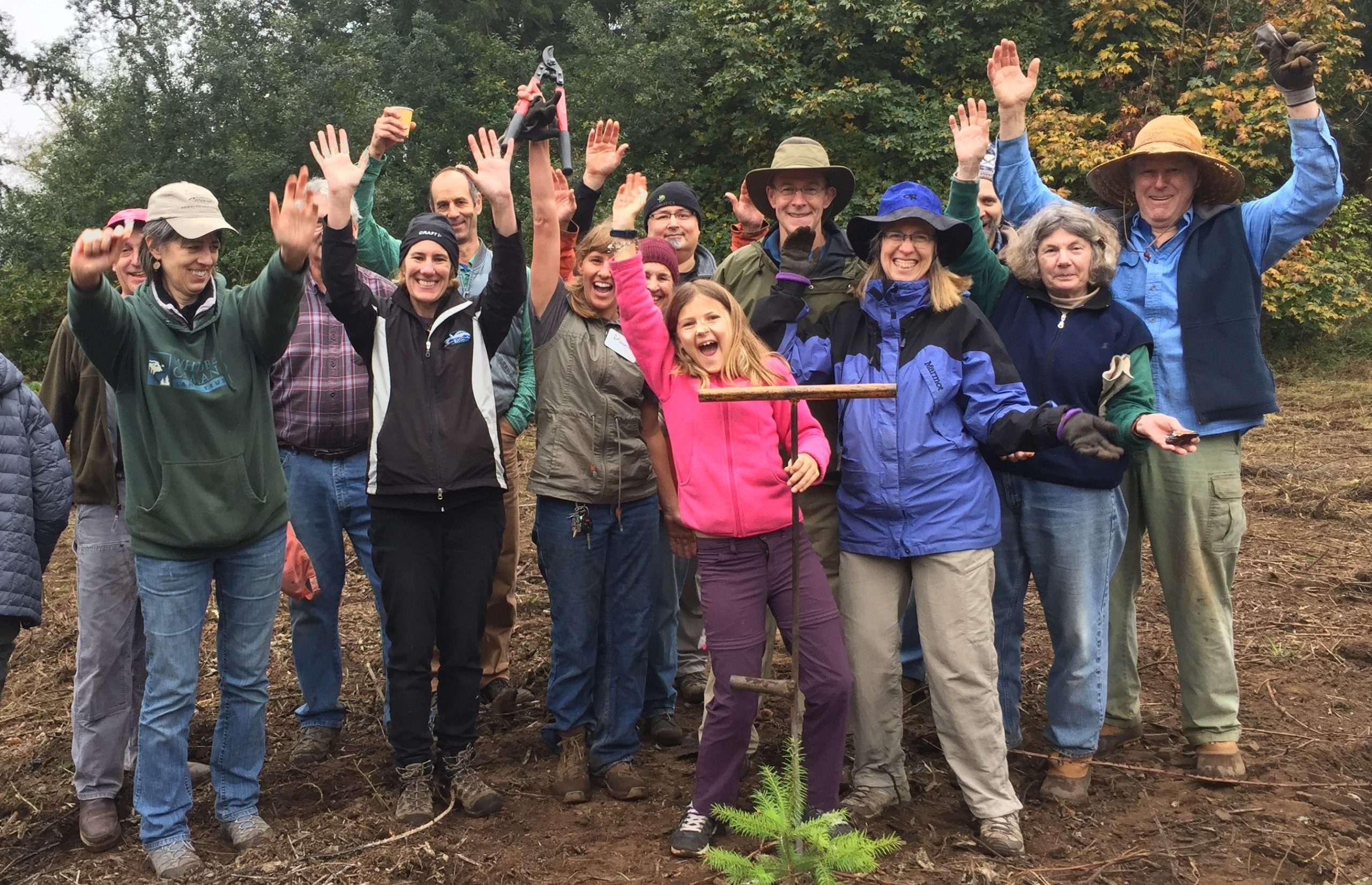
Nature Watch: October’s Palette
About the author: Steve Ellis is a naturalist and Land Trust member who enjoys sharing his love of the natural world. His blog series, “Nature Watch,” will appear each month in “Habitchat,” chronicling native plants and wildlife you can expect to see during that particular time of year. We thank Steve for sharing his passion, illustrating the importance of island conservation.
Overview
October provides one last explosion of color before the onset of the grays of winter. Some of these are bold and eye-catching while others are more subtle. There’s a color for every taste.
Greens: These are easy to find, since conifers make up a large portion of our local forests. Douglas-fir, western hemlock and western red cedar have yellowish-green needles. The foliage of grand fir and shore pine is deep green, while that of Sitka spruce can be bluish-green. Other greens include Oregon grape and sword fern and the broad leaves of madrones and salal
A particular green I look for is that of licorice fern. Fall rains revive their summer-desiccated foliage, turning dead-looking plants into vigorous specimens. Licorice ferns grow on the branches of maples and alders.
Yellows: Yellow is our most eye-popping color in October. The green of photosynthesis fades away, exposing the true colors of deciduous leaves. Willows, maples, thimbleberry and others become quite showy. The colorful leaves last as long as the fall winds allow.
Puget Sound gumplant is a yellow wildflower that grows along seashores. These flowers are hardy, lasting into December. Goldenrod is another late-season bloomer, providing splashes of deeper yellow in meadows, hedgerows and along forest edges.
Orange sulphur butterflies (actually more yellow than orange) can be flying into November. Look for them in areas where their host plants grow – alfalfa, clover and lupines.
Oranges: The leaves of Pacific crabapple are orange in fall, and some salmonberry canes show a delicate golden wash on their bark. Other sources for this hue include the spunky little woodland skipper butterflies, which can be seen in open areas. Their hosts are grasses, and they often nectar on yarrow, goldenrod, asters and weedy plants.
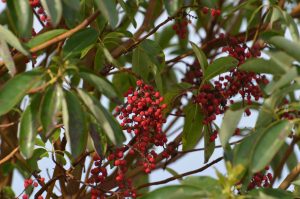
Madrone berries by Martha Ellis.
Several mushrooms are orange. Witch’s butter is a jelly-like fungus found growing on logs, stumps and fallen branches of alders and maples. Orange peel fungus grows as small cups that resemble scraps of orange peelings scattered individually or in clusters along trails and in forest openings.
Red: This color is found primarily among native fruits. Rosehips, bitter cherry fruit, western yew drupes and madrone berries are all reddish. The latter last into January as a food source for birds and when fallen, our local deer.
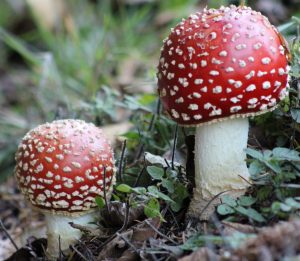
Red fly agaric mushroom by Martha Ellis.
The red fly agaric mushroom, also known as fly amanita, is a fungus that grows on the ground in conifer or mixes woods and along forest edges. Some specimens can have a brilliant Don’t-eat-me! red cap, a warning of their toxicity. The cap often has white or buff “warts” and can measure up to one foot across.
Blue: This can be a difficult color to find in October, especially as clouds turn the skies and the Salish Sea a near-uniform gray. Fortunately, there are some other local blues.
Asters bear late-blooming blue or purplish flowers. They’re hardy, taking on whatever nature throws at them. Look for them in fields along hedgerows and fencelines as well as road rights-of-way. Black raspberry canes have a bluish tint; these grow along forest edges.
There are other colors making an appearance, including the silver of spiderwebs, tans found in grasses and bracken ferns, and the creamy whites of numerous mushrooms, snowberries, and our widespread wildflower, yarrow. A walk through any land trust property will reveal these and other colors to the practiced eye. October’s palette awaits.
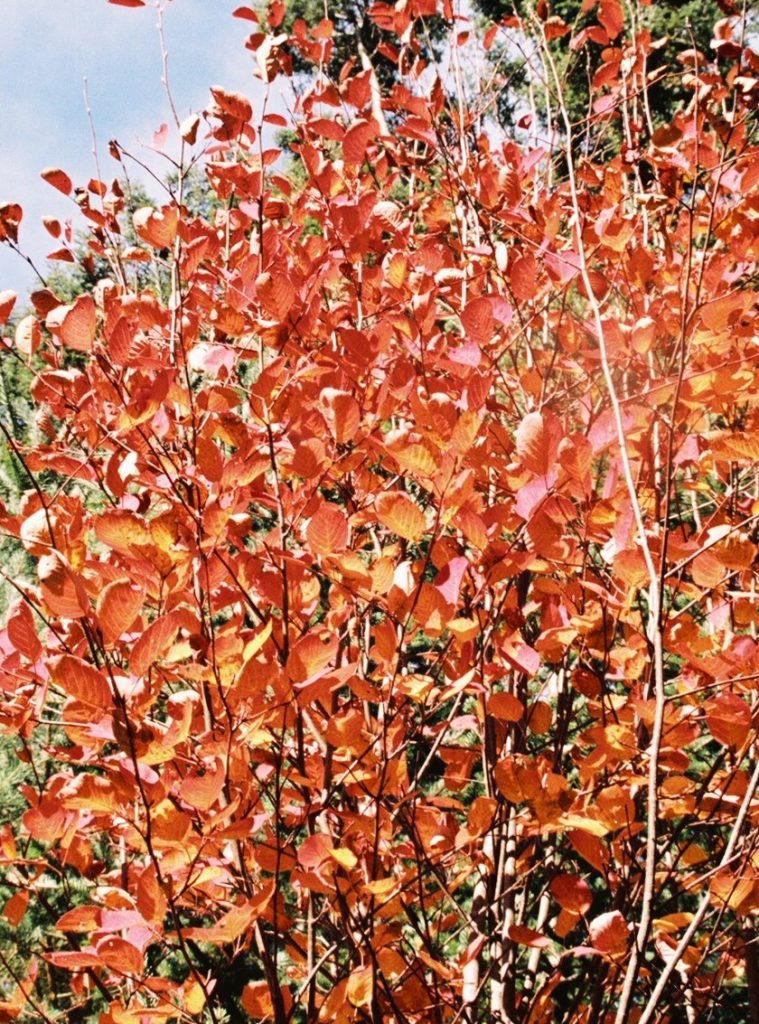
Western Serviceberry by Martha Ellis.
Flora: Western Serviceberry (Amelanchier alnifolia)
Western serviceberry is an important but often-overlooked shrub of our local ecosystems.
Serviceberry grows as a shrub or small tree, reaching heights ranging from three to twenty feet. It sometimes forms thickets, which may be a function of spreading from the root system or the rooting of branch ends that have bent over into the soil.
Leaves are one to two inches long, with toothed edges near the tip. Blooming occurs in the spring with white flowers having five oval or lance-shaped petals. Flowers form in clusters at the branch tips.
Serviceberry blooms are visited by many pollinators including bees and hummingbirds. I’ve noted echo blue and red admirable butterflies nectaring on the flowers in our yard.
Round to egg-shaped purplish-black berries follow pollination. These are favored by many bird species including robins, finches and cedar waxwings. Chipmunks also partake of these fruits.
Deer browse the foliage and small mammals shelter in serviceberry thickets.
In fall, the foliage brightens the landscape with leaves of red, yellow or orange. Look for the colorful serviceberry along forest edges, hedgerows and thickets.
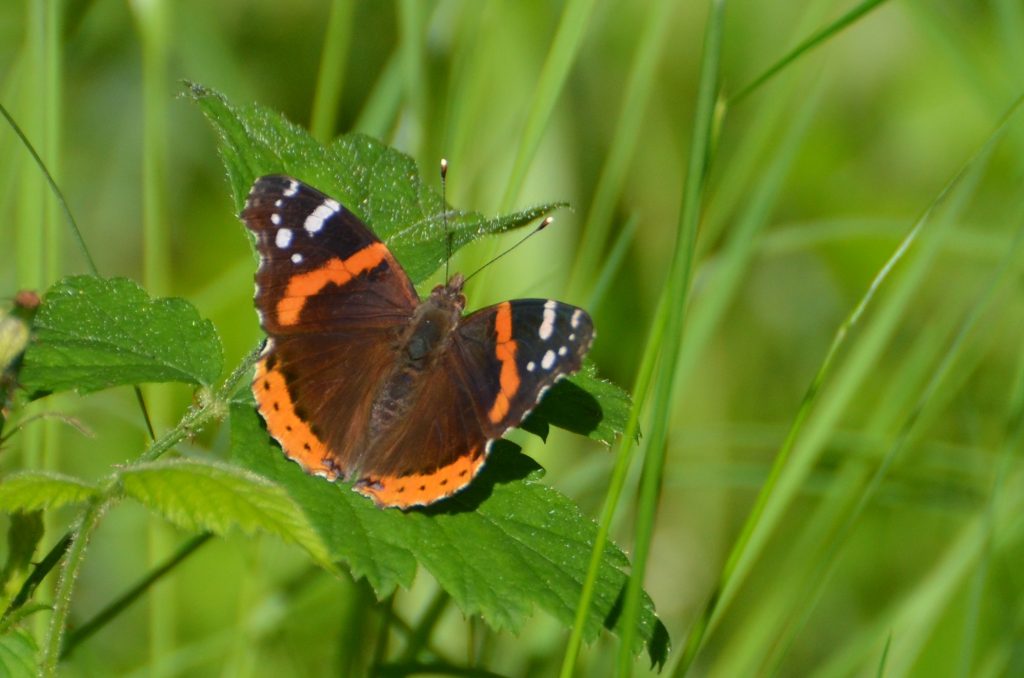
Red Admirable by Martha Ellis.
Fauna: Red Admirable a.k.a Red Admiral (Vanessa atalanta)
This butterfly species has an identity problem. Often known as one of the admirals – and showing some similarities – they are actually members of the genus Vanessa, which are commonly referred to as ladies.
Red Admirables are about 2.5 inches across from wingtip to wingtip, with black and brown upper wings and body. Beautiful bands of scarlet or orange are featured across the fore and hindwings, making a near-circle of blazing color. The underside of the wings is a mix of brownish, blue and buff.
Adult admirables have a wide range of foods they exploit. In addition to nectaring from fireweed, gumplant, blackberry and serviceberry flowers, they also take nourishment from rotting apples and blackberry fruit, willow sap and dung. Sometimes males access the minerals available in mudpuddles.
Red admirables have various methods of dealing with winter. Some probably migrate south, while other individuals may enter a near-hibernation state in a protected spot. Those that migrate to warmer areas don’t live long enough to return. Instead their offspring fly north, appearing in our area as early as April. Their descendants can be out as late as October.
Look for red admirables along the edges of woodlands and in fields, parks and gardens. They can be approached quite closely and may even use you as a perch. Seeing their red or orange “circles” wheeling in flight is guaranteed to brighten your day.

Latest News

Newsletters

Strategic Plan 2024-2028

2027 Calendars Now Available!

Turn Lane Construction at Keystone Preserve

Public Input Meeting: Lagoon Point Community Forest