Nature Watch: The Big Sleep
About the author: Steve Ellis is a naturalist and Land Trust member who enjoys sharing his love of the natural world. His blog series, “Nature Watch,” will appear each month in “Habitchat,” chronicling native plants and wildlife you can expect to see during that particular time of year. We thank Steve for sharing his passion, illustrating the importance of island conservation.
Overview
Shorter days, colder temperatures, and a decrease in the availability of food present a challenge for local fauna. Creatures that neither flee (migrate) nor simply struggle through the winter must find another survival strategy. They engage in the Big Sleep.
A handful of our islands’ mammals hibernate, which involves putting on fat before finding a suitable spot for the duration of winter. Once situated, their body temperature drops along with their heart rate, and their breathing slows down. Some may rouse from time to time, while others don’t awaken for months.
Mammals engaging in this behavior are Townsend’s chipmunks and various bat species.
Local chipmunks excavate individual burrows, often under tree roots or beneath fallen logs. They cache food against long nights and cold temperatures. We’ve seen them in late summer and fall, filling their cheek pouches with maple and other seeds – and once, the seeds of a bitter cherry. No doubt these items were being transported to their burrows. They’ll awaken every few days to eat their food stores.
It’s not entirely clear which bat species hibernate on our islands. A few species migrate southward, while portions of the populations of others move up to caves and rocky scree of the North Cascades. Possible local hibernators include California myotis, silver-haired, and big brown bat. Once I was shown a Townsend’s big-eared bat that had chosen to hibernate in a manmade structure on Whidbey Island.
Torpor is a short-term version of hibernation. Participants include Anna’s Hummingbird and some bat species. For hummingbirds, the periods of low heart rates and slow breathing may be measured in hours rather than weeks and months.
Brumation is the hibernation-like state that reptiles and amphibians experience. These creatures have much cooler body temperatures than birds and mammals, and require less energy to function. They can’t rely on fat reserves to see them through the winter and instead survive by inactivity in a sheltered spot.
Northwestern garter, common garter and possibly western terrestrial garter snakes engage in brumation. These snakes, along with painted turtles and northwestern alligator lizards, need to find appropriate sites for overwintering.
Garter snakes enter mammal burrows, rock piles, crevices and other sheltered spots. There is a scarcity of these sites, which may be a limiting factor on our local snake populations. It’s common for more than one garter snake species to share these winter den sites.
Painted turtles use a different strategy. They swim to the bottom of a pond or lake and bury themselves in the mud. All their body functions slow down by as much as 95 percent. What little oxygen they need is absorbed from the wet mud or taken through their multi-use rectum.
Most adult insects are killed by cold temperatures or starvation. Their offspring enter a phase called diapause, either as eggs or larvae, putting their lives on hold until the return of warmer weather.
Bumblebee populations undergo a radical change when frost kills the old queen as well as all the drones and workers. This leaves only the fertilized new queens, which feed until they fatten and then fill their crops with honey. These proceed to burrow 2 to 6 inches below ground, where their bodies produce glycerol, a natural antifreeze.
Many people inadvertently bring hibernating wasps indoors with their firewood. Like bumblebees, these are fertile queens that had sought winter slumber in a woodpile.
You can observe insect brumation by following these tips:
- Check woodpiles for sheltering wasps and other invertebrates,
- Look for galls, those roundish knobs that grow from the stems of roses, willows and cattails among others. The galls have bromating fly or midge larva.
- Scan the underside of your eaves for moth cocoons.
- Use a hand lens to find the pupa of insects tucked into the bark of Douglas-fir and bigleaf maple.
- Ocean spray and other shrubs may have a dead leaf that is rolled up and sewn into a bag, the work of a Lorquin’s admiral butterfly.
- All of these -creatures and more are trusting they can survive the Big Sleep.
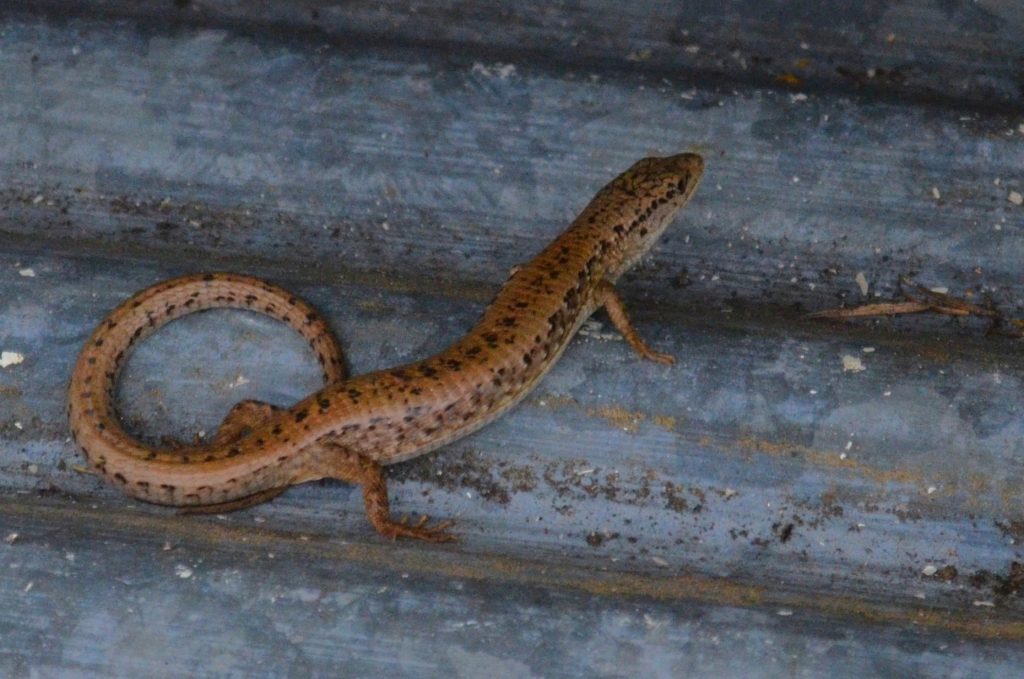
Northern alligator lizard by Martha Ellis.
Fauna: Northern Alligator Lizard (Elgaria coerulea)
Some people are surprised to learn there are native lizards on our islands.
Northern alligator lizards grow to a length of 10 inches. They are grayish-brown to dark brown above and grayish below, with some individuals having a greenish wash. They have brown eyes. Adults show a fold or ridge that runs along each side of the body.
This is the only lizard species west of the North Cascades and north of Mason County. They inhabit hedgerows, thickets, open areas and beaches. They’re also found in forests with clearings that will enable them to bask in sunlight.
Northern alligator lizards enter brumation when the ambient temperature drops to and stays below 50°. This usually means October or November. They remain dormant until the following spring. Mammal burrows, beneath rotting logs and under woodpiles are typical wintering spots.
Mating in this species occurs in spring after emergence. Eggs are retained in the female for up to three months. The young at birth are less than 3 inches long.
Prey for northern alligator lizards includes beetles, moths, ants, spiders and slugs. In turn, snakes, owls, hawks and weasels eat the lizards. When under a serious threat from one of these predators, the tail may detach and keep thrashing while the lizard makes its escape.
Take a closer look along the top of the driftwood on a sunny, warm day next spring. You may be rewarded with a sighting of one of our local short-legged, armored lizards.
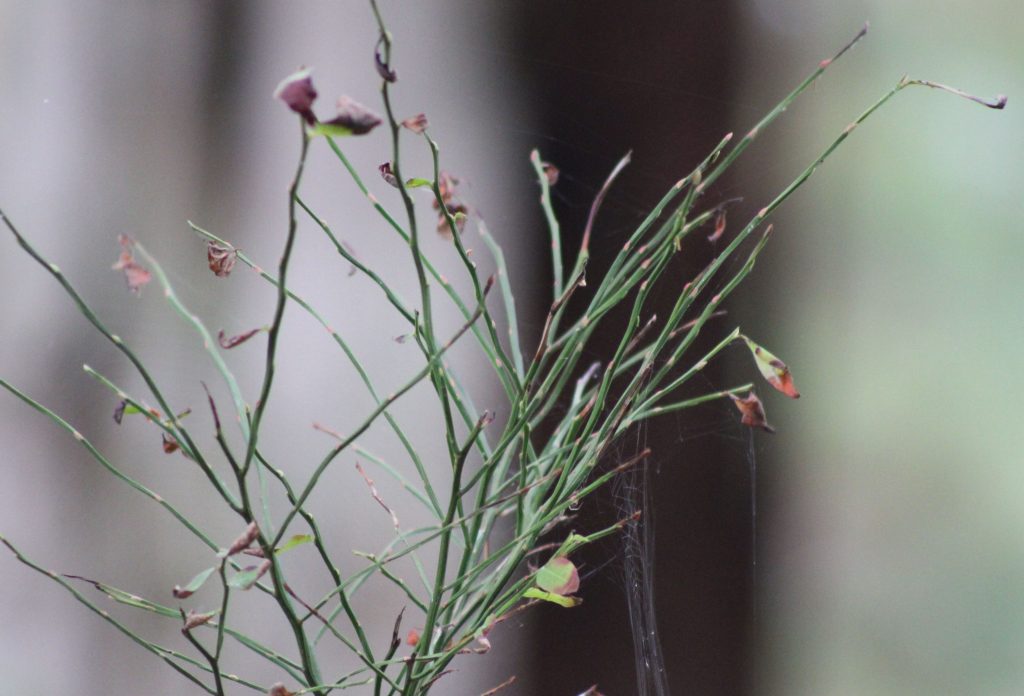
Red huckleberry by Martha Ellis.
Flora: Pacific Rhododendron vs. Red Huckleberry
There are significant differences in how evergreen and deciduous trees and shrubs respond to cold weather.
Pacific rhododendron, our state flower, is a broadleaved evergreen. Unlike deciduous shrubs, it retains the majority of its leaves in the fall and employs a different strategy to survive winter’s cold temperatures.
The stately rhododendron can be thought of as a living outdoor thermometer.
As the temperature drops, the leaves droop and curl, helping to prevent frost damage. The drooping begins at 35°F. When the freezing level is reached, leaves begin to curl inward. Temperatures below 25° will cause the foliage to curl more tightly, giving the leaves the appearance of green cigars. They’ll hold that pose until revived by sustained warmer temperatures.
Red huckleberry is a deciduous shrub that manages to have it both ways. It drops most of its leaves as with all deciduous shrubs, but may retain up to 10 percent of its foliage. The stems and twigs remain green, allowing the plant to quickly jump-start photosynthesis should the sun shine in winter. This also gives them a head start in spring, before the leaves of overshadowing alders and other deciduous trees grow to block sunlight from reaching the forest floor.
These are just two examples of how our local flora responds to the time of The Big Sleep.

Latest News

Newsletters

Strategic Plan 2024-2028

2027 Calendars Now Available!

Turn Lane Construction at Keystone Preserve

Public Input Meeting: Lagoon Point Community Forest