Nature Watch: Holiday Letter Bragging Rights
About the author: Steve Ellis is a naturalist and Land Trust member who enjoys sharing his love of the natural world. His blog series, “Nature Watch,” will appear each month in “Habitchat,” chronicling native plants and wildlife you can expect to see during that particular time of year. We thank Steve for sharing his passion, illustrating the importance of island conservation.
Overview
Some people follow a tradition of sending holiday greeting cards with a letter extolling their family’s accomplishments. This blog is Nature’s greeting card from Whidbey and Camano Islands, and includes many surprising superlatives.
Camano:
- Livingston Bay Tidelands is an exceptional birding spot. Shorebirds such as Dunlin visit the beach, while flocks of Snow Geese and Trumpeter Swans rest on the bay. Now is a good time to look for the “big white birds.” The bay also holds salmon and sturgeon.
- Camano has two underappreciated state parks, Camano Island and Cama Beach. We were delighted with the number of bird species that visited our campsite at the former earlier this year. We’ve also seen orcas from the park’s beach.
- Gray whales are regular visitors to Camano Island waters. The spring migration for these behemoths is April-May. Beaches at the two state parks are good lookouts as the whales transit the area. In spring, check out the Mabana Beach boat launch. At high tide, gray whales prey on ghost shrimp nestled in the mud. (Please don’t trespass on adjacent private property.)
Whidbey:
- The greatest concentration of loons in our state occurs at Deception Pass. Hundreds of Red-throated Loons gather to prey on surf smelt traveling through the pass. The spectacle starts in December and peaks in January.
-
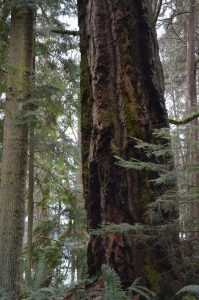
Old-growth at Hoypus Point National Forest by Martha Ellis.
If large trees are of interest, then you need to walk into the Hoypus Point Natural Forest section of Deception Pass State Park. At 1,400 acres, this is the second largest block of old growth remaining in the Salish Sea lowlands. Only Moran State Park on Orcas Island is bigger. The Hoypus forest is a mix that includes redcedar, Douglas-fir, hemlock, Sitka spruce and bigleaf maple. There’s no bad time to visit, except during violent windstorms. Some of the towering Douglas-firs are hundreds of years old.
- The rocky beaches of Penn Cove attract flocks of Black Turnstones. There have been some years when the local Christmas Bird Count tallied more of these small shorebirds than anywhere else in the world. Look for them from pullouts along Madrona Way and at Oak Harbor’s waterfront Windjammer Park. At high tide, they’re often resting on the log boom at the Oak Harbor marina boat launch. December is an excellent time to see turnstones.
- At 36,308 acres, the Smith and Minor Islands Aquatic Reserve is the largest aquatic reserve in Washington State. It boasts the biggest bull kelp bed in the Salish Sea. The overall kelp bed is diverse, hosting many species including one discovered here. The kelp, and other seaweed species, support a huge array of fish, which in turn attracts sea birds and marine mammals. The best birding occurs in fall and spring.
- The islands themselves are part of the San Juan Island National Wildlife Refuge. They host breeding species such as Rhinoceros Auklet and Tufted Puffin. Many marine mammals haul out there – a pair of binoculars will help you check the buoy off Ft Ebey State for northern sea lions that use it to rest.
- Deer Lagoon and Crockett Lake are two Whidbey locations that are designated Important Bird Areas by the National Audubon Society. Crockett Lake is known for shorebirds, waterfowl and raptors. Late summer through spring is the time for the most bird diversity. Deer Lagoon has shorebirds and waterfowl, and the birding is good year-round.
Both islands:
- The largest octopus species in the world is the giant Pacific octopus. They have been spotted off Deception Pass, Admiralty Inlet, and in the cold, deep waters of Saratoga Passage. Average adult giant Pacifics weigh 33 pounds and can have an arm span of 14 feet. Some large individuals attain a weight of 400 pounds!
- Gumboot chitons are the largest chiton species in the world. The foot-long gumboots can be found in the intertidal zone. Look for their white “butterfly-shaped” shells on the beaches of Camano Island’s parks and along Whidbey’s west side.
- Almost half of all the Salish Sea’s Pigeon Guillemots nest in burrows excavated in the coastal bluffs of our islands. These puffin relatives catch fish on the sea bed. The best time to observe guillemots is during their exuberant courtship phase, which occurs in April and May.
- Saving the best for last, the Whidbey Camano Land Trust protects 12,000 acres, including forests, wetlands, farms, prairies, and 16 miles of coastline. They have a dedicated staff powered by generous donors.
As you can see, this particular holiday letter has many bragging rights to share. My wish for all of you is that you have the opportunity to experience these special places in the coming year. Happy Holidays!
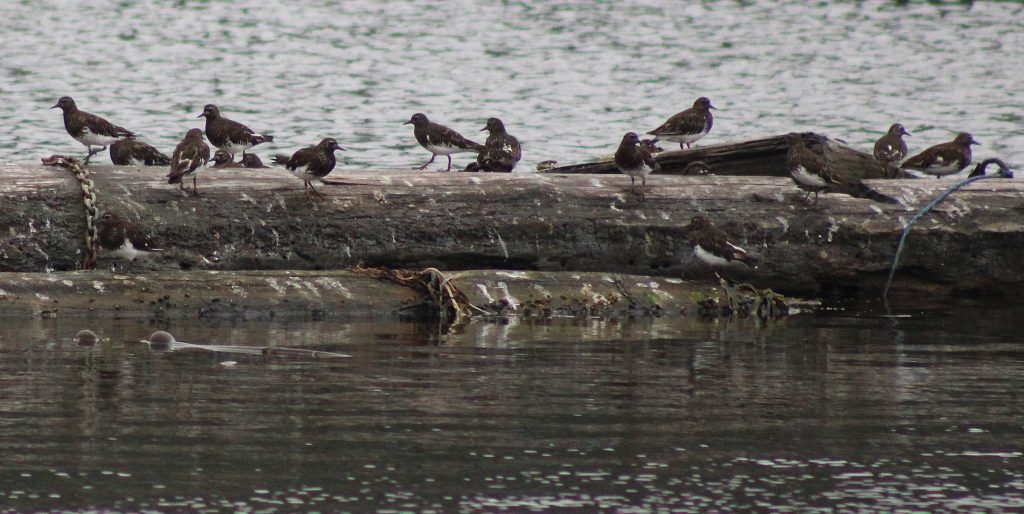
Black Turnstones by Martha Ellis.
Fauna: Black Turnstone (Arenaria melanocephala)
The high-pitched calls of Black Turnstones may well be heard before you see the birds themselves, as they blend in so well with our rocky shorelines.
Black Turnstones are 9 inches long, with a wingspan of 21 inches. The head, breast and upper parts are black, contrasting with the white belly. Legs are a darkish-orange and they have a short, tapered bill.
Turnstones are named for their habit of flipping over objects on the beach to expose food items. They mostly eat barnacles, snails and limpets found on rocks, but also “spatula” seaweed aside to find other marine invertebrates hidden under the blades. Acorn barnacles, a favorite food, are accessed either by inserting the bill and leveraging it open or hacking it apart. Only the soft parts of the prey are swallowed.
Other shorebird species sometimes mix with turnstones, including Surfbirds and Rock Sandpipers. Occasionally a Sanderling, a somewhat smaller species, will defend an individual turnstone from other Sanderlings. The defender chases off others of its own kind so that it can dash in to pick up prey exposed by its beneficiary.
Black Turnstones nest on the tundra of western Alaska. The eggs and chicks are hardy, a good trait in an area where bad weather is a year-round threat.
Many predators look to prey on turnstones on the breeding grounds, including gulls, jaegers, Sandhill Cranes, falcons and foxes. Parent turnstones will run or fly under a fox approaching vulnerable chicks or eggs to drive it away. Aerial predators are attacked by pulling on their tail feathers.
Turnstones’ main predators in winter are falcons, so flocks will often fly high over the water in a zig-zag pattern to avoid them. We once witnessed a group of turnstones hunker down on the beach, appearing to be just so many dark rocks. A puzzled falcon made a circle overhead and then dashed off to find prey elsewhere.
Small flocks of turnstones start arriving on our local beaches in late August, and a few failed breeders may arrive in July. Most will fly north again by mid-May, but a few may stay to summer in the area.
Flocks of Black Turnstones can be seen along the shores of Penn Cove. At high tide, search for them out on the mussel rafts. Oak Harbor’s Windjammer Park hosts turnstones on the beach at low tide, and they’re often found resting on the log boom at the marina when the tide is in. On Camano, check out Camano Island State Park for these intriguing shorebirds.
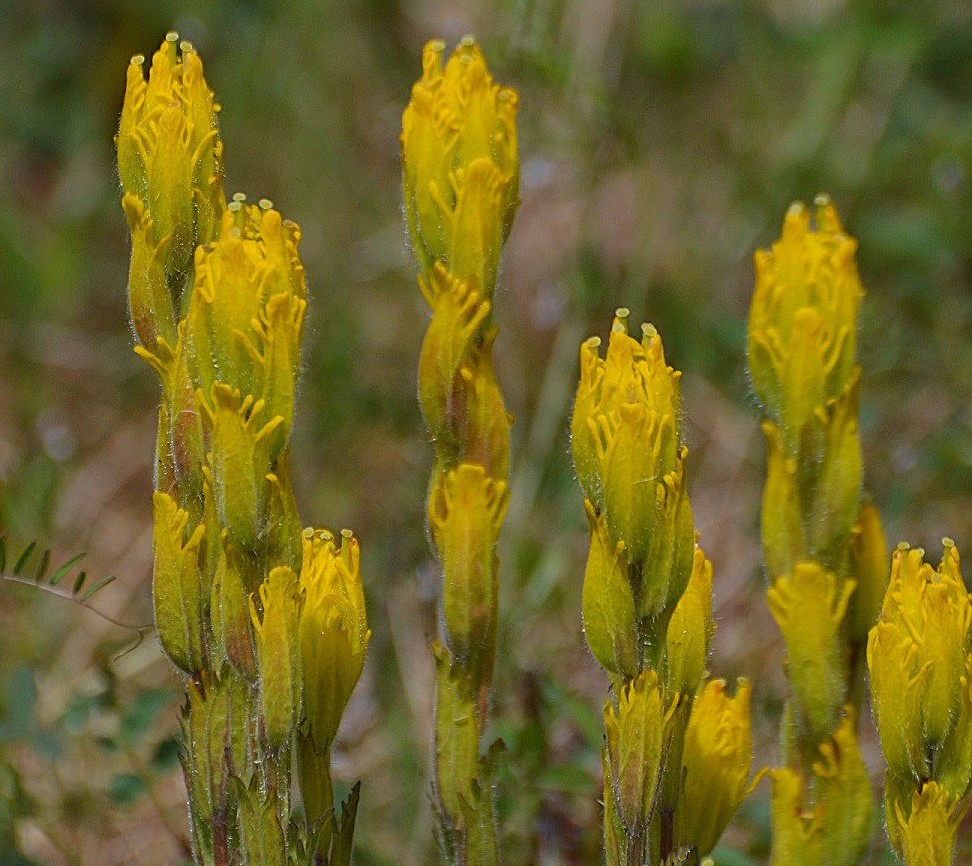
Golden paintbrush by Martha Ellis.
Flora: Golden Paintbrush (Castilleja levisecta)
More golden paintbrush grows on Whidbey Island than practically anywhere else in the world. A resident of our glacial outwash prairies, this plant brings stunning color wherever it lives.
Golden paintbrush grows as a multi-stemmed plant that reaches 10 to 12 inches high. Leaves are lobed and lance-shaped and are somewhat sticky and hairy. Leaves higher on the stems tend to be broader than those near the base.
Flowers of this paintbrush are small and green and tucked into the large golden-yellow bracts that give this plant its name. Flowering usually begins in May and lasts through June.
Bumblebees appear to be the main pollinator of golden paintbrush in our region. Tiny seeds held in capsules are dispersed short distances by late-summer and fall winds. Animals may also inadvertently transport seeds.
Deer, rabbits and voles eat golden paintbrush. The former may also trample the plants, as do humans who stray away from designated trails. Aside from being eaten or trampled, this paintbrush can be killed via shading from taller plants. Traditionally, those shrubs and tall grasses would be swept away by wildfires. Native peoples burned some prairies to promote the growth of edible plants such as camas, a practice which also benefited the paintbrush.
Golden paintbrush is a hemi-parasite, meaning a host plant is necessary. It connects with the roots of yarrow, woolly sunflower or Idaho fescue in order to obtain water and nutrients and cannot survive for long on its own.
Look for golden paintbrush in Whidbey Camano Land Trust’s Admiralty Inlet Natural Preserve, Fort Casey State Park, and the Pacific Rim Institute. While not in bloom at this time of year, you can see this perennial during the offseason.

Latest News
Newsletters

Strategic Plan 2024-2028
2027 Calendars Now Available!

Turn Lane Construction at Keystone Preserve

Public Input Meeting: Lagoon Point Community Forest