
Nature Watch: A Snail’s Pace
About the author: Steve Ellis is a naturalist and Land Trust member who enjoys sharing his love of the natural world. His blog series, “Nature Watch,” will appear each month in “Habitchat,” chronicling native plants and wildlife you can expect to see during that particular time of year. We thank Steve for sharing his passion, illustrating the importance of island conservation.
Overview
August is a great time to get in some beachcombing. The month has ample daylight, which means a low tide occurs while the sun is out. Also, the seashells you find tend to be intact as opposed to those deposited by winter storms that batter the shore.
Napoleon Bonaparte is often credited with saying that an army marches on its stomach. Whether that’s a true attribution or not, some sea creatures literally travel on theirs. These include snails and limpets, which are classified as gastropods – meaning they glide on their “stomach foot.”
There are many species of marine snails in our region, ranging in size from the tiny dove snail to the giant Lewis moon snail. Other species include dogwinkles, turbans, and the carnivorous whelks. A favorite among beachcombers are the colorful top snails
Marine snails glide along at a top speed of 3 miles per hour. Most dine on algae and other organisms scraped from rocks. Some inhabit seaweeds where they eat bull, ribbon and other species of kelp.
Whelks eschew algae and instead deploy a tongue-like structure called a radula to attack other shellfish. The radula has teeth formed from minerals extracted from seawater. A whelk uses its radula to bore a hole into its victim.
Other common gastropods are in the limpet family. Limpets are single-shelled creatures found mainly on rocks, though some are tiny enough to inhabit kelp. They’re often seen as lumps attached to rocks during periods of low tide.
Compared to snails, limpets are slowpokes, traveling a mere quarter of an inch per minute. They deploy mucous to help them glide along in search of algae to eat.
Limpets use their radula to scrape algae from rocks. Their teeth, held in multiple rows, are the strongest in the world, composed of a hard iron-hydroxide mineral up to 13 times stronger than steel. They need to be strong in order to support the limpets’ unusual lifestyle.
Each limpet selects a home rock and proceeds to scrape out a scar that perfectly fits its shell. They employ their radula, assisted by the edges of their shell to create the scar. Once situated, a limpet’s muscular “foot” becomes a suction cup to cinch the animal down. Special mucous helps seal the shell to the rock.
During high tides, limpets wander freely as they graze. Sensing the outgoing tide, they head toward their home rock, retracing the route by following their mucous trail. Limpets must find their scar and reattach to the rock in order to avoid drying out.
Limpets have few predators when they are hunkered down, but some sea stars and predatory snails can overcome their defenses. Occasionally you’ll find an empty limpet shell that’s damaged along one side. This is the work of a Black Oystercatcher, a large shorebird species, that pried the limpet off its rock in order to gain a meal.
There are many species of limpets. Those that inhabit rocks exposed to crashing waves have low profiles, while limpets found in less forbidding conditions may have peaked shells. Keyhole limpets are among the latter.
Many good field guides and websites are available to help you identify snails and limpets. The best beachcombing times are an hour before and 1½ hours after low tide. By going one to two hours before the lowest water, you can view the movements of snails and limpets as they go about their business.
You’ll be rewarded with wonderful observations if you proceed at a snail’s pace.
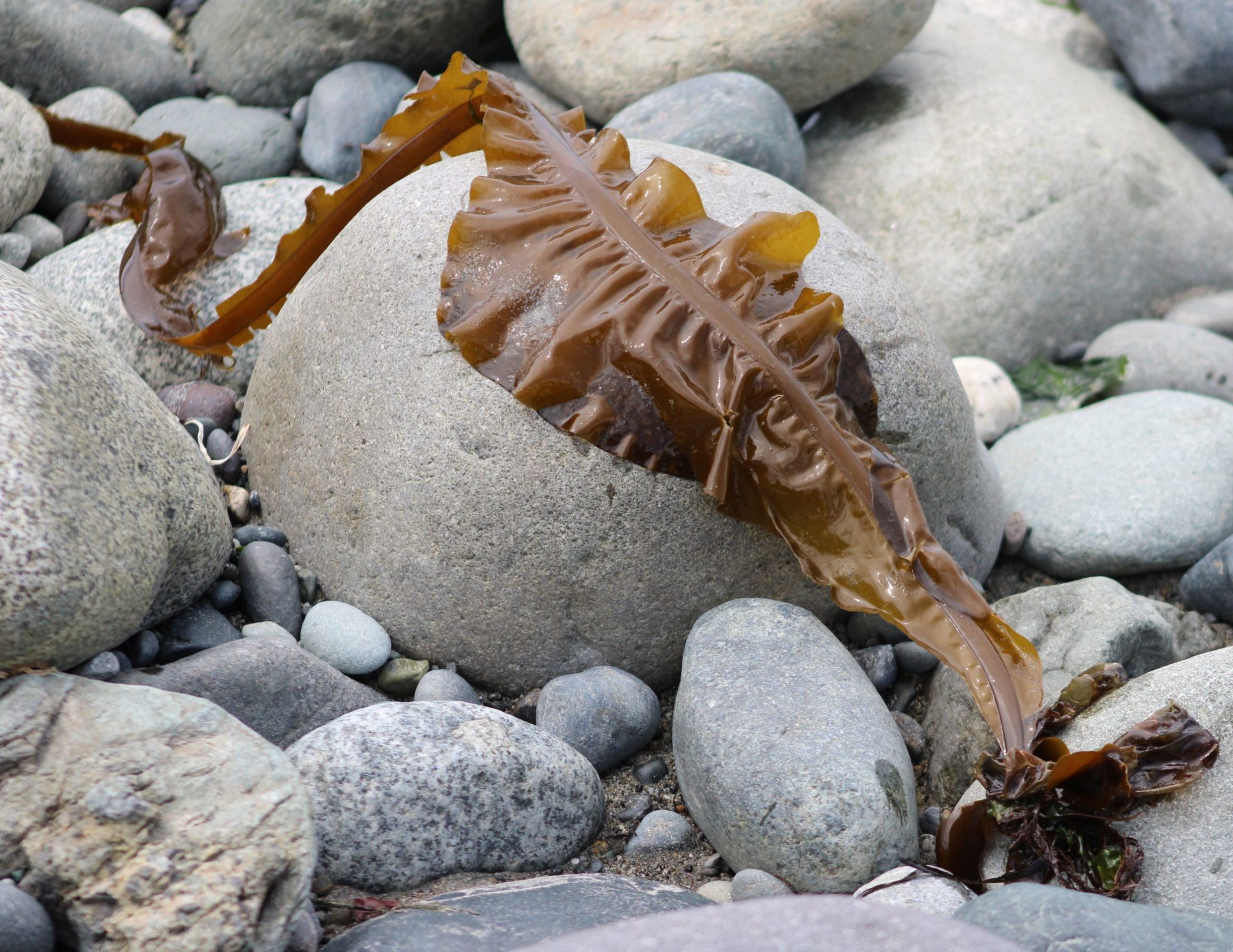
Ribbon kelp by Martha Ellis.
Flora: Ribbon Kelp (Alaria marginata)
This seaweed is an important component of the kelp forests found off our shores.
Classified as a brown algae, ribbon kelp has narrow, olive-green to brown blades attached to short stipes (stems). The blades have conspicuous midribs and wavy edges. The entire length of 10 to 13 feet grows in one year.
In spring and summer, small oval reproductive blades grow from the base of the stipe. These release spores in August which settle on rocks, becoming the next generation. The young kelp grow quickly in winter, adding as much as 1½ to 2 inches per day.
Summer growth rates surpass those of winter as the blades take in nutrients such as nitrogen, carbon and phosphorus. Several minerals also contribute, and by August the kelp will have reached its full size.
Ribbon kelp, along with other species, provides cover for invertebrates and small fish. Larger fish, birds, otters and seals are attracted to the bounty found in kelp forests. This species also helps protect beaches from erosion caused by wave action.
A host of herbivores grazes on ribbon kelp. These include small snails, kelp crabs and sea urchins. As a defense, the kelp produces chemicals that repel the invertebrates. The largest concentration of these chemicals is in the reproductive blades.
Fall and winter storms batter the kelp, eventually ripping the old blades from the rocky substrate. The detritus, known as wrack, is deposited on the beach where it is inhabited by beach hoppers and other scavengers. Shorebirds come to pick through the wrack to find the invertebrates feasting on the ruined kelp blades.
Many shores around our islands host this important and attractive seaweed. Whidbey Island’s Libbey Beach and Fort Ebey State Park are my go-to places to find it.
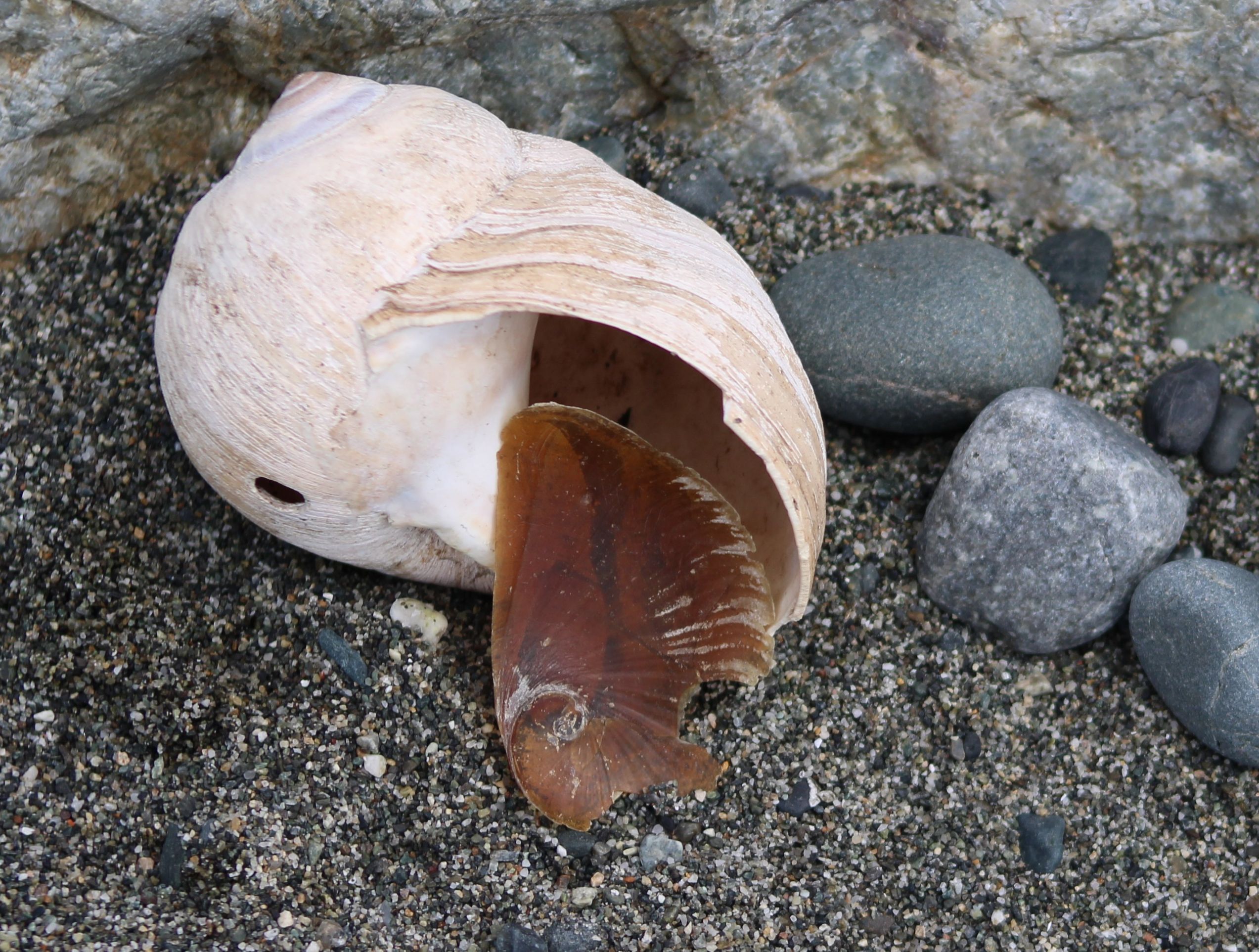
Lewis moon snail by Martha Ellis.
Fauna: Lewis Moon Snail (Neverita lewisii)
Named for the explorer Meriwether Lewis, this intriguing snail is the largest of its kind in the world.
Moon snails are so called because of the crescent or half-moon-shaped opening located on the underside of the shell. This species grows to 5½ inches in diameter. The cream-colored shell protects a muscular “foot” that helps them glide along the bottom sediments.
Lewis moon snails plow through loose materials while searching for prey. Victims are detected through a chemical process similar to smelling. Their usual prey are clams but they also eat other snails and the eggs of Pacific herring.
When a clam is located, the snail engulfs it with its mantle and then employs the radula. It takes two to three days to drill into the clamshell. Enzymes and acids are injected to liquify the clam’s tissues, and the snail extends a tube to suck up the resulting mixture.
These behemoth snails can live up to 15 years. Despite their size, they do have their own predators, including gulls, octopuses, sunflower sea stars and red rock crabs. When danger is detected, the snail’s foot is retracted into the shell and a stiff ‘door’ called an operculum, attached to the foot, seals the opening.
Lewis moon snails spend the winter in deep water, moving into the shallows in late spring. Summer is the season for reproduction. A female creates a collar on the seabed, made of sand mixed with mucous. Tiny eggs are laid in the structure and covered with more sand. Fully-made collars resemble earthen pots and may reach a diameter of 15 inches. You can find the collars by wading into the shallows at low tide, but they should be left undisturbed.
Look for moon snail shells along beaches that have sandy sediments or very fine gravel.

Latest News

Newsletters

Strategic Plan 2024-2028

2027 Calendars Now Available!

Turn Lane Construction at Keystone Preserve

Public Input Meeting: Lagoon Point Community Forest