Nature Watch: Living on the Edge
About the author: Steve Ellis is a naturalist and Land Trust member who enjoys sharing his love of the natural world. His blog series, “Nature Watch,” will appear each month in “Habitchat,” chronicling native plants and wildlife you can expect to see during that particular time of year. We thank Steve for sharing his passion, illustrating the importance of island conservation.
Overview
Humans living on the edge are said to be taking risks or indulging in a thrilling lifestyle. In the natural world, life on the edge has a different meaning.
Edge habitat occurs where two ecosystems converge. These are seen nearly everywhere: along forests and road rights-of-way, shore and ocean, thickets and fields. These edges are often biodiversity hotspots.
What makes edges so biologically prolific is the combination of available resources. For example, plants growing next to a forest receive more precipitation and sunlight compared to those located in the woods. At the same time, they may be protected from wind by the trees.
The best forest edges have a gradual or “feathered” transition from low vegetation to shrubs to trees. Shrubby dense tangles offer protection from predators and the elements and are often chosen for nest sites. These areas also produce abundant food resources in the form of seeds, berries and invertebrates for many bird species. Wrens, sparrows and finches thrive on this abundance.
Lakes, ponds and other wetlands often have a border of tall, shrubby vegetation. Here the edge consists of willows, twinberry and other bushes that tolerate wet soils. A host of birds take advantage of this cover, feasting on insect life and using the foliage for nests. It’s one of the most productive habitats for warblers and other small birds.
Thickets and hedgerows next to fields make excellent edge habitat. They are highways and way-stops for birds reluctant to travel long distances without nearby cover. Many birds and small mammals such as shrews and voles spend time in a hedgerow or thicket and then enter the adjacent field to forage.
Safety isn’t always guaranteed in a thicket, however. I once was lying on the ground on my stomach, peering into a North Whidbey hedgerow, when a long-tailed weasel grabbed a White-crowned Sparrow. Our eyes locked on each other’s before the weasel frisked away with its prize.
Beaches can be thought of as a kind of edge too, separating the ocean from the adjoining uplands. This edge is inundated by high tides, which means the larder gets restocked on a regular basis. Snails, small crabs and other invertebrates utilize both the exposed portion of beaches and the parts that are underwater. Upland creatures such as raccoons and birds are drawn to the bounty provided by the sea.
As valuable as edge habitat is, there can be too much of a good thing. Forest fragmentation produces a great amount of edges but that space comes at a high price. Specialists such as Humboldt’s flying squirrel, Pileated Woodpecker and others require large blocks of trees. Cutting too much of the forest breaks down the natural order. Predation increases, invasive non-native plants thrive, and weather seriously impacts life found in the forest. Eventually the biodiversity drops precipitously in these areas.
When exploring a new place, I always start by checking the edge habitats. It’s the best shortcut to discovering the wildlife that’s residing there. You don’t need to be a risk-taker to enjoy life on the edge.

Black Twinberry by Martha Ellis.
Flora: Black Twinberry (Lonicera involucrata)
While many honeysuckle species are climbing vines, black twinberry grows as an erect shrub that can reach a height of nine feet. Taller specimens tend to lean over. The leaves are lance-shaped and attached to twigs with short stems.
The blossoms of twinberry are pairs of short, yellow tubes tinged with red. They are protected by purplish or red bracts. Flowing occurs from late April through June.
Twinberry blossoms attract bumblebees, hummingbirds and butterflies. After these pollinators have done their work-, black-colored berries ripen in the mid- to late summer sun and last well into fall.
Twinberry berries are eaten by Cedar Waxwings, finches, robins and other birds. Seeds are then scattered through excretion.
Birds use black twinberry for other purposes. Some build nests in the branches while others glean insects from the foliage. Often twinberry is the tallest shrub in the area, making it useful for a male to sing from a lofty perch.
Deer tend to only eat twinberry’s new growth and reject the twigs and branches of well-established shrubs.
Black twinberry thrives in moist soils and does well in full sun or partial shade. It’s an edge species, growing in hedgerows, bordering forests, and along margins of wetlands. It has a robust root system that helps anchor soils and is often used for restoration projects.
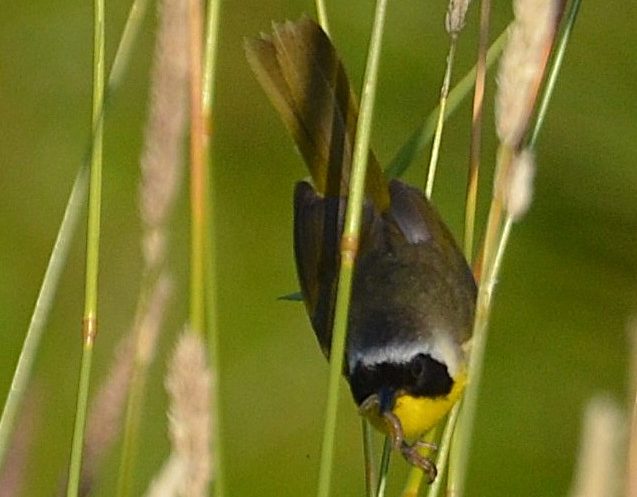
Common Yellowthroat by Martha Ellis.
Fauna: Common Yellowthroat (Geothlypis trichas)
Along with the vocalizations of Red-winged Blackbirds, the Common Yellowthroat’s “wichity-wichity-wichity” song is emblematic of the border between uplands and wetlands.
Common Yellowthroats are a species of warbler measuring five inches long. The male is bright yellow below and greenish-brown above. A black mask bordered in white contrasts with the stunning yellow throat.
Males of this species begin arriving from their Central American wintering grounds in April. They are joined by the females a week later, giving the males a cushion of time to get territories established for the breeding season.
Females select the nest site, usually on the ground or just above it in a bush. They construct bulky cup nests, occasionally putting a roof on top. Two to six eggs are laid. Females do the incubation while both parents feed the nestlings.
Yellowthroats eat a variety of insects and other invertebrates found on the ground, in mud, and gleaned from willows, hardhack, and twinberry growing on the edge of wetlands. There are many places to find these birds on our islands. Look and listen for Yellowthroats wherever there is thick vegetation next to wetlands. A sight of a male Common Yellowthroat in the sunshine is breathtaking and memorable.

Latest News

Newsletters

Strategic Plan 2024-2028

Turn Lane Construction at Keystone Preserve

Public Input Meeting: Lagoon Point Community Forest

2026 Summer Employment Opportunity